Construction on Isla Mujeres: Island Building Challenges & Solutions
Updated September 2026 • By Recrea Construction • 6 min read
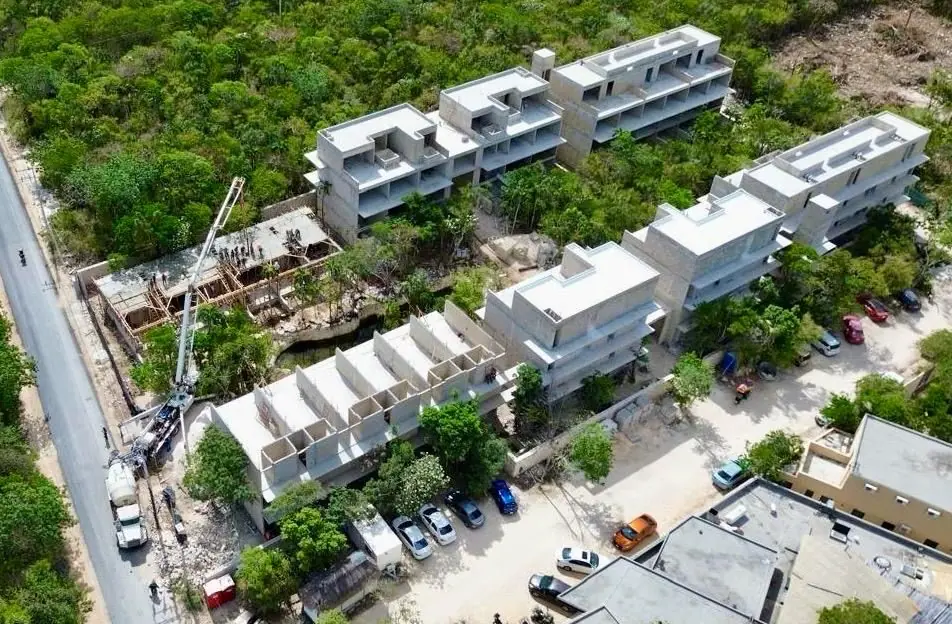
Isla Mujeres is eight kilometres long, half a kilometre wide at its widest, and everything that becomes a building there arrives by water. That single fact reorganises a construction project: procurement becomes a scheduling discipline, waste removal becomes a cost line, and a forgotten box of fixings becomes a lost day rather than a lost hour.
Add the most aggressive salt exposure in the state — the island is surrounded by sea on all sides, with almost no position more than a couple of hundred metres from the water — plus finite utilities and a municipal administration of its own, and you have a build that rewards planning far more than it rewards speed. This guide covers the logistics, the corrosion specification, the utility constraints, and what the island premium actually is.
Logistics: Everything Arrives by Water
Materials reach the island by cargo barge from Puerto Juárez or by the vehicle ferry, and the practical consequences dominate the programme:
- Aggregate, block, cement and steel all ship in. There is no local quarry or aggregate source of consequence, so the base materials that are cheap on the mainland arrive with freight attached.
- Barge scheduling, not just-in-time delivery. Deliveries are batched. That means accurate quantity take-offs, storage space on a small site, and protection of stored material from salt and rain — and it means a take-off error is expensive rather than annoying.
- Concrete supply is the classic constraint. Either it is barged as ready-mix within a workable window, or it is batched on site from imported materials, which affects quality control and the pour strategy. Plan pours as events, with contingency.
- Waste goes back off the island. Demolition and construction debris removal is a real, quotable cost that mainland projects barely notice.
- Narrow streets and access. Much of the island cannot take a large truck or a concrete pump of any size. Golf carts and small vehicles are the local reality, and the last 50 metres of a delivery is sometimes manual.
- Trades travel daily unless they are housed on the island, so the working day is shortened by the crossing at both ends, or accommodation goes in the budget.
Net effect on cost: expect roughly 25–40% above equivalent mainland Cancún construction, concentrated in materials, logistics and time rather than in labour rates.
Corrosion: the Most Aggressive Exposure in the State
No part of Isla Mujeres is meaningfully sheltered from marine air, so the specification that is prudent on the mainland coast is mandatory here.
- 316 stainless for all exposed fixings, fasteners and hardware — railings, gates, window furniture, pergolas, light fittings, pool fixtures. 304 will pit and tea-stain.
- Anodised aluminium or marine-grade powder coat for all glazing and exterior aluminium. Standard architectural powder coat does not last here.
- Increased concrete cover and denser, less permeable mixes on every exposed element, with cover controlled on site by spacers and the pour cured properly. Chloride-induced spalling is the island's signature long-term defect.
- Galvanised plus painted (duplex) protection for any structural steel, with connections and site welds treated rather than touched up.
- Marine-rated electrical enclosures, gasketed, with drip loops, and AC condensers specified with coated coils — uncoated coils corrode and lose capacity within a few years.
- Fresh-water rinse points designed into terraces and pool surrounds, because periodic rinsing is the cheapest maintenance regime available for stainless and glass.
Build the maintenance cycle into the handover documentation: on this island, a building that is not rinsed and inspected annually ages roughly twice as fast as one that is.
Get a Free Quote in 2 Minutes
Tell us about your project — we respond via WhatsApp faster than any builder in the Riviera Maya
Water, Wastewater and the Permit Layer
Utilities are finite, and this shapes what a project can be. Potable water is supplied to the island, and capacity is not unlimited — which makes rainwater harvesting, low-flow fixtures, greywater reuse and, for hotel-scale projects, desalination or substantial storage genuine design questions rather than sustainability decoration. Wastewater must be treated properly: the island sits in a marine-park environment with the reef and Punta Sur protections nearby, and discharge quality is central to any environmental file. Electricity comes by submarine cable, so the load you request matters, and solar with storage is attractive both economically and as resilience.
Permits run through the municipality of Isla Mujeres — which, it is worth noting, also administers a stretch of the mainland including Playa Mujeres. State environmental review via SEMA applies, federal jurisdiction applies in the maritime zone and around protected areas, and hotel or commercial projects add Civil Protection and, in a national park context, additional federal consultation. Height and density limits on the island are deliberately restrained, so verify the specific lot's classification before designing anything — an island lot's realistic envelope is often smaller than a buyer assumes.
| Project | MXN/m² | USD/m² |
|---|---|---|
| Renovation of an existing house | $12,000–$22,000 | $670–$1,220 |
| New house, mid-range, full marine spec | $22,000–$30,000 | $1,220–$1,670 |
| Premium / seafront villa | $30,000–$45,000+ | $1,670–$2,500+ |
| Small boutique hotel, per key | $1,300,000–$3,600,000 per key | $72,000–$200,000 per key |
Renovation is the island's most common work, and it is where the biggest surprises live: opening up a twenty-year-old house frequently reveals corroded reinforcement, failed waterproofing and electrical installations that have to be replaced rather than extended. Budget a contingency of 15–20% on any island renovation, and have the structure assessed before you commit to a scope.
Frequently Asked Questions
We Build Across the Riviera Maya
Playa del Carmen
Our home base since 2008. Playacar, Centro, Ejidal, Colosio, Coralina — we know every colonia and every permit office.
Tulum & Aldea Zamá
Eco-builds, boutique hotels, jungle villas. Full SEMA/SEMARNAT permit handling. Eco-regulation experts.
Puerto Aventuras
Marina-front villas, canal homes, gated community construction & renovation since 2010.
Cancún & Hotel Zone
Commercial builds, restaurant fit-outs, condo renovations in Zona Hotelera and residential zones.
Akumal & Puerto Morelos
Beachfront construction, eco-resorts, residential builds in protected coastal zones.
Bacalar & Felipe Carrillo Puerto
Emerging market — boutique hotels, eco-lodges on the Lagoon of Seven Colors.
Ready to Start Your Project?
196+ projects completed. Fixed-price contracts. Free detailed estimate within 48 hours.
Get Free QuoteWhy Build with Recrea
- 196+ projects completed across the Riviera Maya — Playa del Carmen, Tulum, Puerto Aventuras, Cancún, Akumal, Bacalar since 2008
- Fixed-price contracts — itemized budget, no surprises, penalty clauses for delays
- All services in-house — architecture, permits, construction, electrical, plumbing, carpentry, metalwork, pool
- Bilingual team — English/Spanish/German communication with weekly photo and video reports
- 100% permit approval rate — land use, SEMA, construction license, civil protection, all inspections
- 14 rescued projects — we've taken over and completed projects abandoned by other builders
- 1-year structural warranty — we stand behind our work with written guarantees