Jungle House Construction in Tulum: Eco-Build Guide 2026
Updated July 2026 • By Recrea Construction • 6 min read
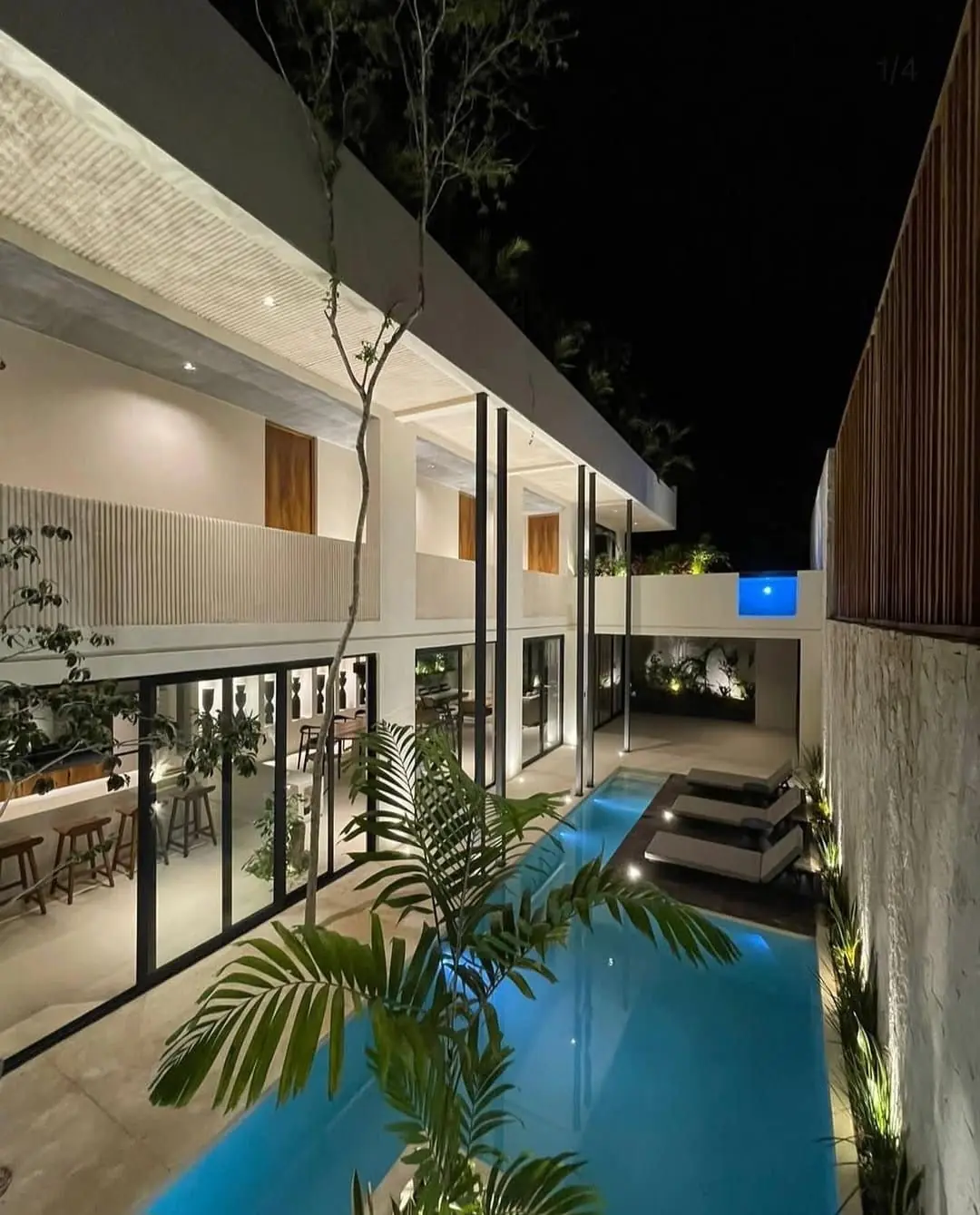
A jungle lot in Tulum is the most attractive land in the corridor and the most demanding to build on. The selva is protected vegetation, the ground is cenote-riddled karst, most parcels have no CFE service or municipal water, and the house you put there will be surrounded by the two things that destroy buildings in the tropics: constant humidity and an enormous termite population.
Done properly, the result is the best kind of house on this coast — shaded by mature canopy, quiet, cool without much air conditioning, and worth substantially more to rent than an equivalent house on a cleared lot. This covers the permits, the off-grid decisions, the detailing that keeps the jungle out of the structure, and the cost lines that only exist on this kind of land.
Vegetation, Cenotes and the Environmental File
On a jungle lot the environmental file is the project's critical path, and it is driven by the land rather than the house.
- A vegetation survey comes first. An inventory of what is on the lot, what species are protected, and what you propose to remove. This drives both the authorisation and the design, and it is the cheapest way to learn whether the house you want fits the land you are buying.
- Clearing is authorised, not assumed. Expect to justify each removal, to be limited to a proportion of the lot, and increasingly to commit to retaining or replanting. Designs that thread between mature trees are approved more readily than designs that need a clear site — and they produce better houses.
- Cenotes and sinkholes impose setbacks and restrictions on what may infiltrate nearby. A cenote on the lot is simultaneously an extraordinary asset and a hard constraint; map it before designing.
- Wastewater is the technical centre of the file. Treatment before infiltration, sized to occupancy, with the absorption well or field set back properly. What infiltrates in Tulum reaches the aquifer and then the reef, and this is what the review examines hardest.
- Authorities: municipality of Tulum for land use, licence, alignment and DRO; SEMA for state environmental impact; SEMARNAT and CONAGUA where federal jurisdiction or water matters arise.
- Timeline: plan for months rather than weeks, and file early. Tulum's review is the most environmentally demanding in the corridor, which is appropriate and is not negotiable.
Off-Grid by Design, Not by Accident
Get the CFE extension quoted before you buy — it ranges from around $150,000 MXN on a lot near an existing line to well over $900,000 further out. That number decides the whole services strategy.
- Solar with storage, sized to real loads. A house designed for cross-ventilation with inverter mini-splits used selectively, LED lighting and efficient appliances needs a fraction of what people assume. Typical credible systems for a jungle house: $300,000–$800,000 MXN depending on loads and autonomy.
- Water: a well with treatment, rainwater harvesting into a cistern, or both. With 1,200+ mm of annual rainfall, harvesting is genuinely productive here and the water is soft, which is a bonus for the plumbing and the pool.
- LP gas for cooking and hot water, with a stationary tank sized for the delivery interval — not exchange cylinders on a jungle track.
- Biodigester or package treatment plant sized to occupancy, with the absorption field positioned with regard to any cenote and the water table.
- Internet by fixed wireless or satellite, and it is worth solving properly: remote-worker guests are the strongest long-stay rental segment for this kind of house.
- Access road. The line nobody budgets. A few hundred metres of cleared and surfaced access can run $40,000–$300,000 MXN, needs its own clearing authorisation, and determines whether concrete trucks can reach the site at all — which changes the construction method.
Designing off-grid from the start is very different from retrofitting it. Roof geometry for harvesting and panels, a plant room sized for batteries and treatment, load discipline in the appliance schedule, and a plan that works with the breeze so cooling is optional — all decided on the first sketch.
Get a Free Quote in 2 Minutes
Tell us about your project — we respond via WhatsApp faster than any builder in the Riviera Maya
Keeping the Jungle Out of the Building
Termites and humidity are the two forces working on a jungle house continuously. The detailing that resists them:
- No timber-to-ground path anywhere. Concrete pads, galvanised or stainless shoes, decks and platforms held above grade. Subterranean termites here will find any continuous route from soil to timber.
- Soil treatment before the slab, and a physical barrier at penetrations. This is cheap during construction and disruptive afterwards.
- Dense hardwoods or treated timber only for anything structural or exposed — machiche, ipé, cumaru, tzalam. Untreated pine in a jungle house is a meal.
- Ventilate everything: a gap behind joinery carcasses, vented plinths, air under decks, and no sealed cavity that traps humidity against timber or plaster.
- Continuous conditioning or dehumidification in closed rooms, particularly in a house that sits empty between visits. A humidistat-controlled dehumidifier is the difference between returning to a fresh house and returning to a mouldy one.
- Mosquito screening designed in, not added — screened openings, screened terrace sections, and a plan that lets you sleep with air moving.
- Sealed, rodent-resistant service penetrations, and a plant room that closes properly. The jungle is full of things looking for shelter.
- Keep the canopy but manage it: no branches overhanging the roof (they deliver debris, humidity and a bridge for insects), and a cleared zone immediately around the building while the wider lot stays intact.
Cost. Construction on a Tulum jungle lot runs $17,000–$26,000 MXN/m² for mid-range to premium work, with the site-specific lines — environmental file $80,000–$300,000, off-grid services $300,000–$800,000, access $40,000–$300,000, treatment plant $90,000–$250,000 — often adding up to more than a third of the total. Which is the real lesson of jungle lots: the house is the predictable part of the budget, and the land is where the money and the time actually go.
Frequently Asked Questions
We Build Across the Riviera Maya
Playa del Carmen
Our home base since 2008. Playacar, Centro, Ejidal, Colosio, Coralina — we know every colonia and every permit office.
Tulum & Aldea Zamá
Eco-builds, boutique hotels, jungle villas. Full SEMA/SEMARNAT permit handling. Eco-regulation experts.
Puerto Aventuras
Marina-front villas, canal homes, gated community construction & renovation since 2010.
Cancún & Hotel Zone
Commercial builds, restaurant fit-outs, condo renovations in Zona Hotelera and residential zones.
Akumal & Puerto Morelos
Beachfront construction, eco-resorts, residential builds in protected coastal zones.
Bacalar & Felipe Carrillo Puerto
Emerging market — boutique hotels, eco-lodges on the Lagoon of Seven Colors.
Ready to Start Your Project?
196+ projects completed. Fixed-price contracts. Free detailed estimate within 48 hours.
Get Free QuoteWhy Build with Recrea
- 196+ projects completed across the Riviera Maya — Playa del Carmen, Tulum, Puerto Aventuras, Cancún, Akumal, Bacalar since 2008
- Fixed-price contracts — itemized budget, no surprises, penalty clauses for delays
- All services in-house — architecture, permits, construction, electrical, plumbing, carpentry, metalwork, pool
- Bilingual team — English/Spanish/German communication with weekly photo and video reports
- 100% permit approval rate — land use, SEMA, construction license, civil protection, all inspections
- 14 rescued projects — we've taken over and completed projects abandoned by other builders
- 1-year structural warranty — we stand behind our work with written guarantees