Modern Minimalist House in Playa del Carmen: Design & Costs 2026
Updated July 2026 • By Recrea Construction • 6 min read
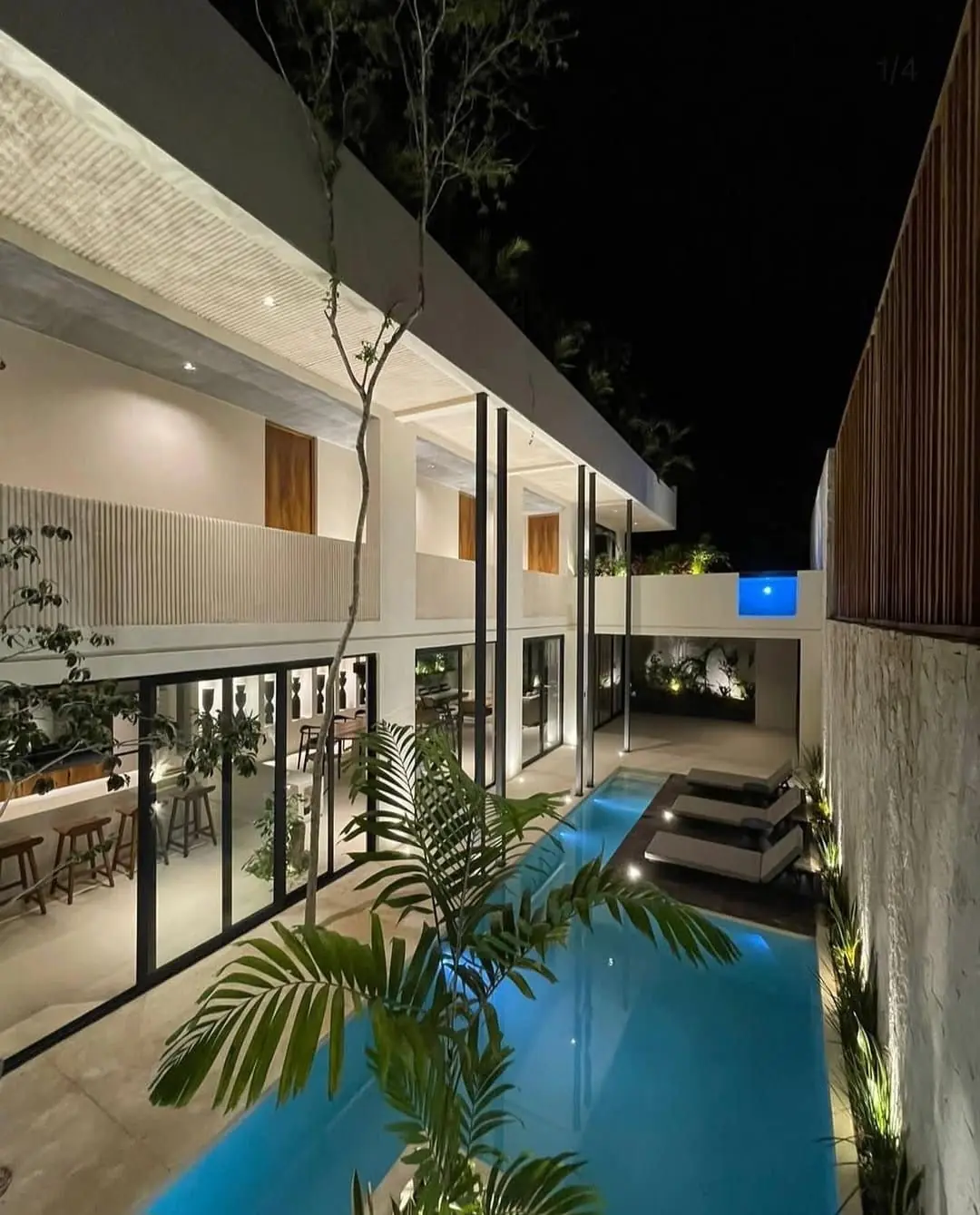
Minimalism is the dominant architectural language on this coast, and it is considerably harder to execute here than the finished photographs suggest. A minimalist house removes the mouldings, reveals, drips and trims that conventional detailing uses to hide tolerance and to control water. What is left is flat planes meeting flat planes — in a climate with 1,200 mm of annual rain, driven horizontal rain, extreme UV and thermal movement.
Done well, it is the right architecture for the Riviera Maya: it suits the light, it works in chukum and concrete which are local materials, and it frames the landscape rather than competing with it. Done badly, it is a house with cracked render, stained walls and water in places water should not be. This is what separates the two.
The Materials That Belong Here
- Chukum. A regional lime-and-bark render with a soft, mineral, slightly mottled finish that suits this light better than paint ever does. It is breathable, it ages gracefully, and it is what gives Tulum and Playa del Carmen architecture its particular surface. It needs skilled application — it is applied wet, in passes, by people who have done it before — and it needs periodic sealing, particularly on horizontal or splash-exposed surfaces and around pools.
- Polished and burnished concrete for floors and occasionally walls. Excellent locally: hard, cool, and it takes the light well. Control joints have to be designed rather than cut wherever convenient, and the surface needs sealing on a schedule.
- Microcement over existing substrates, useful in renovation where a monolithic look is wanted without demolition. Thin, so substrate movement telegraphs through — the substrate preparation is the whole job.
- Exposed concrete (concreto aparente). Spectacular and unforgiving: the formwork quality, the pour, the vibration and the curing are all permanently visible, and in a marine environment cover and mix density matter even more than usual because there is no render to protect the reinforcement.
- Local stone — regional limestone and coralline stone — as cladding and paving, tonally exactly right for the palette.
- Large-format porcelain where a stone look is wanted without sealing and staining. Practical, especially around pools and in rental properties.
What does not belong: dark surfaces in full sun (too hot to touch, and thermally punishing), imported timber cladding (it will not survive), delicate powder-coated metalwork close to the sea, and high-gloss anything — gloss shows every deviation in a flat plane, and flat planes here are large.
Flush Details Still Have to Drain
This is where minimalist houses fail, and almost all of the failures are water. Minimal detailing removes the elements that traditionally manage water, so each one has to be reinvented deliberately.
- Flush thresholds need a channel drain and a slope away from the opening, with a drained and vented sill behind the frame so water that passes the outer seal escapes outward. A flush threshold without that is a funnel into the house.
- Frameless and minimal-frame glazing concentrates the entire weather line into a slim joint. That means top-grade systems, proper structural silicone, thermal breaks against condensation, and installation into square openings with correct anchorage. This is not a place to value-engineer.
- Parapets and flat roofs need drips and a defined edge even when the intent is a clean line — otherwise water runs back under the coping and streaks the wall below. A concealed drip does the job invisibly.
- Drainage falls are non-negotiable. A visually flat roof or terrace still needs real slope to real outlets, with overflows. Ponding finds every weakness.
- Hidden gutters and concealed downpipes must be oversized and accessible for cleaning. A blocked concealed gutter is a roof leak with no visible cause.
- Movement joints designed into large uninterrupted planes. Thermal movement here is significant, and a 12-metre unjointed chukum wall in full sun will tell you so.
- Shadow gaps instead of skirtings only work if the floor drains and the wall base is detailed for cleaning water. Otherwise they collect everything.
Get a Free Quote in 2 Minutes
Tell us about your project — we respond via WhatsApp faster than any builder in the Riviera Maya
Hidden Services and the Real Cost of Precision
Minimalism hides the services, which means the coordination has to happen before anything is built. Recessed linear air-conditioning diffusers and their plenums, concealed curtain and blind tracks, shadow-gap lighting with drivers somewhere accessible, flush access panels for valves and filters, no visible conduit, no surface-mounted anything. Every one of those is a decision made at the MEP coordination stage — on a minimalist house, the engineering drawings are the architecture.
And it costs more. The paradox clients find hardest is that a house with less in it is more expensive, because the tolerance is tighter and the labour is more skilled.
| Element | Cost reality |
|---|---|
| Overall premium over conventional detailing, same area | +10–25% |
| Chukum, applied and sealed, per m² | $450–$1,100 MXN |
| Polished / burnished concrete floor, per m² | $700–$1,800 MXN |
| Microcement over prepared substrate, per m² | $900–$2,200 MXN |
| Minimal-frame sliding glazing, per m² | $14,000–$30,000 MXN |
| Recessed linear AC diffusers and plenums (per unit) | $12,000–$35,000 MXN |
| Concealed lighting, tracks and access panels | Adds 15–30% to the lighting and joinery package |
The honest advice we give clients who want this architecture on a tight budget: reduce the area rather than the detailing. A smaller minimalist house executed precisely is a good building; a large one executed loosely is a house with cracked planes and water stains, and the photographs that sold you on the style were of the former. Choose the two or three moves that matter — the big glazed opening, the chukum walls, the flush terrace threshold — and spend properly on those.
Frequently Asked Questions
We Build Across the Riviera Maya
Playa del Carmen
Our home base since 2008. Playacar, Centro, Ejidal, Colosio, Coralina — we know every colonia and every permit office.
Tulum & Aldea Zamá
Eco-builds, boutique hotels, jungle villas. Full SEMA/SEMARNAT permit handling. Eco-regulation experts.
Puerto Aventuras
Marina-front villas, canal homes, gated community construction & renovation since 2010.
Cancún & Hotel Zone
Commercial builds, restaurant fit-outs, condo renovations in Zona Hotelera and residential zones.
Akumal & Puerto Morelos
Beachfront construction, eco-resorts, residential builds in protected coastal zones.
Bacalar & Felipe Carrillo Puerto
Emerging market — boutique hotels, eco-lodges on the Lagoon of Seven Colors.
Ready to Start Your Project?
196+ projects completed. Fixed-price contracts. Free detailed estimate within 48 hours.
Get Free QuoteWhy Build with Recrea
- 196+ projects completed across the Riviera Maya — Playa del Carmen, Tulum, Puerto Aventuras, Cancún, Akumal, Bacalar since 2008
- Fixed-price contracts — itemized budget, no surprises, penalty clauses for delays
- All services in-house — architecture, permits, construction, electrical, plumbing, carpentry, metalwork, pool
- Bilingual team — English/Spanish/German communication with weekly photo and video reports
- 100% permit approval rate — land use, SEMA, construction license, civil protection, all inspections
- 14 rescued projects — we've taken over and completed projects abandoned by other builders
- 1-year structural warranty — we stand behind our work with written guarantees