Multi-Family House in the Riviera Maya: Investor Construction Guide
Updated July 2026 • By Recrea Construction • 6 min read
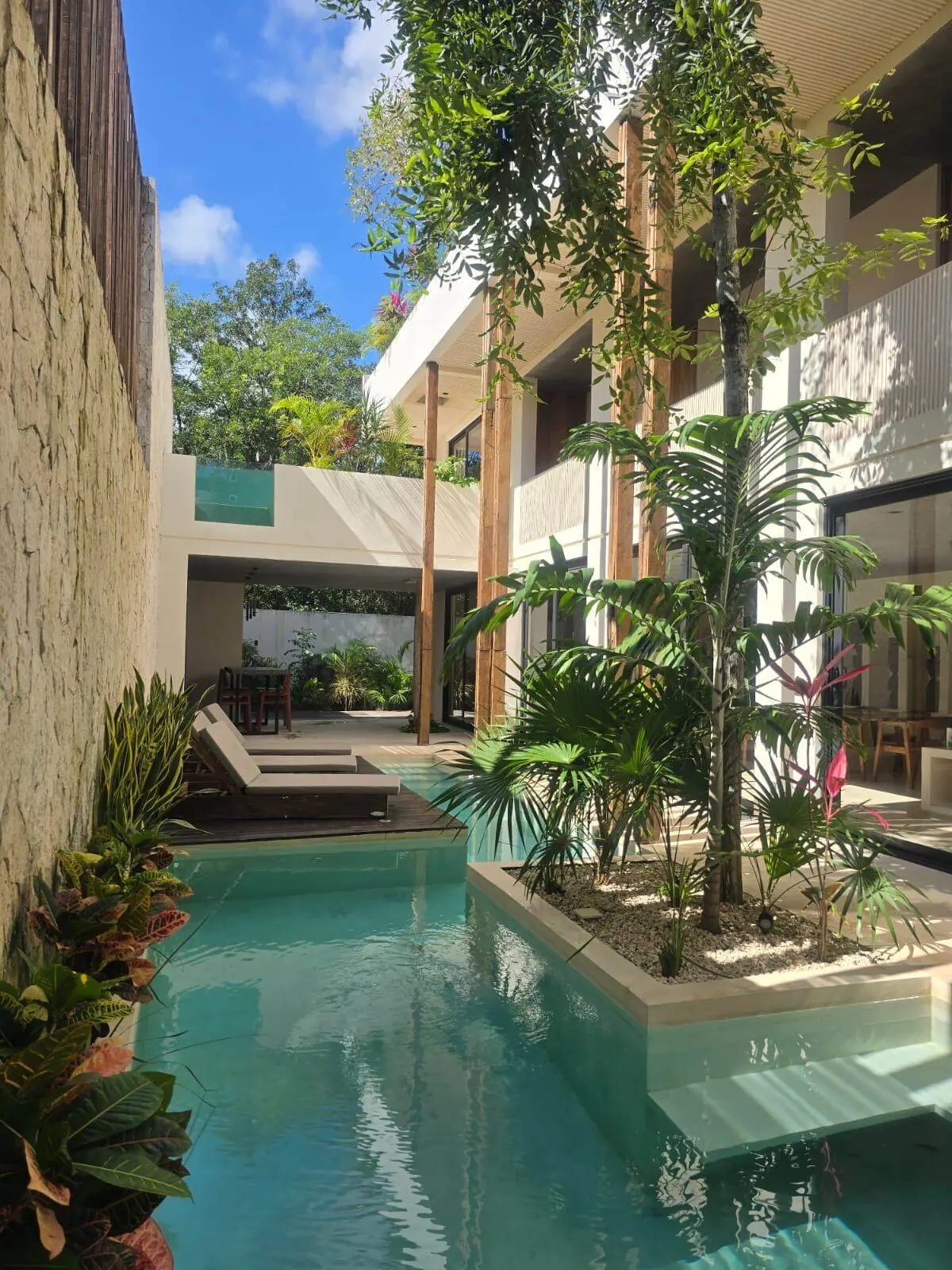
A duplex, triplex or fourplex is the most efficient way to convert a single lot into rental income on this coast. One set of foundations, one roof structure, one service connection and one permit process serve several revenue streams — and the incremental cost of the second and third unit is far below the cost of the first.
What determines whether the project works is not construction. It is the land-use classification, the parking requirement, and whether you intend to sell units individually — which turns the project into a condominium regime and changes the legal work substantially. This covers all three, plus the design and metering decisions that make small multi-family buildings easy to operate.
Density, Parking and What the Lot Permits
Check these before anything else, and get them in writing for the specific lot.
- Land use must permit multi-family. A lot zoned for single-family housing does not become multi-family because the building looks like one house. This is the most common fatal flaw in these projects.
- Density (units per lot or per hectare) caps the unit count independently of the area you are allowed to build. Two lots with identical CUS can permit different numbers of units.
- COS and CUS then cap footprint and total built area, as always.
- Parking is the constraint that most often reduces the unit count. Municipalities require a number of spaces per unit, sometimes more for larger units, and those spaces have to fit on the lot with workable manoeuvring. On a narrow urban lot, parking — not floor area — is usually what decides whether you build three units or four.
- Setbacks, height and storeys as for any project, plus any requirement for private open space or common area.
- Services capacity. Four units need a water connection, cistern and electrical service sized for four households. CFE load requests and water connections for multi-family are a different application than for a house.
Run this check as part of lot due diligence. We have reviewed plenty of lots marketed as ideal for small apartment buildings whose density or parking numbers permitted two units, not the four in the seller's pitch.
Condominium Regime: Only If You Intend to Sell Units
This is the decision that shapes the legal and cost structure of the project.
- If you will own and rent the whole building, you do not need a condominium regime. One title, one owner, units rented as apartments. Simpler, cheaper, and you keep full control of how the property is used.
- If you intend to sell units individually, you need a condominium regime (régimen de condominio): a notarised instrument dividing the property into private units and common elements, with participation percentages, bylaws, and the common-area rules. That is a separate legal process with its own cost and timeline, and it usually needs to align with the construction licence and the as-built condition.
- Establish it at the right moment. Setting up the regime is cleanest when the building is designed for it — unit boundaries, separately metered services, independent access, and a clear separation of private and common elements. Retrofitting a regime onto a building designed as one house is possible but messier and more expensive.
- Write the bylaws for your actual intent. If units will be sold to investors who plan to rent short-term, the bylaws should permit it explicitly. If you want a residential building, say so. Bylaws are what future owners fight over.
- Pre-sale implications. Selling units off-plan brings obligations and buyer expectations of its own; the permits and the regime need to exist before you market, not after.
Get a Free Quote in 2 Minutes
Tell us about your project — we respond via WhatsApp faster than any builder in the Riviera Maya
Design, Metering and Cost Per Unit
Small multi-family buildings that are cheap to operate share a set of features:
- Separate meters for everything possible. Individual CFE meters per unit, and individual water metering where it can be arranged. Shared utilities in a rental building mean either you absorb the cost or you argue about it monthly.
- One plant area, properly sized: cistern and pressure system for full occupancy of all units, treatment plant sized for the total, LP tanks, and equipment accessible without entering any unit.
- Independent access to each unit, ideally without shared internal corridors — external stairs and separate entries reduce common-area maintenance and suit the climate.
- Acoustic separation between units, which is the single most common complaint in small buildings here and is cheap during construction: a proper party-wall build-up, no rigid connections between floors and partitions, and resilient layers under upper-floor finishes.
- Private outdoor space for every unit — terrace, patio or roof share. On this coast, a unit without outdoor space rents at a real discount.
- Standardised fittings across all units, so one set of spares serves the whole building and maintenance is fast.
- A pool if the site allows, sized and positioned as a shared amenity with clear safety provision; it lifts rates across every unit.
| Configuration | Construction MXN/m² | Notes |
|---|---|---|
| Duplex, two units, shared structure | $15,000–$21,000 | Cheapest per m² of the multi-family options |
| Triplex / fourplex, two storeys | $16,000–$23,000 | Circulation and parking start to consume area |
| Small apartment building, 6–10 units | $17,000–$25,000 | Lift, fire and Civil Protection requirements may apply |
| Condominium regime, notary and legal set-up | $150,000–$600,000 total | Only if selling units individually |
| Services for a 4-unit building (cistern, treatment, meters) | $350,000–$900,000 total | Sized for full occupancy of all units |
The economics: per square metre, multi-family construction sits close to single-family, but the cost per revenue-producing square metre is better because circulation and plant are shared, and the land cost is divided across units. The risks are concentrated in the pre-construction phase — density, parking and land use — which is exactly where a couple of days of verification is worth more than anything you can do later.
Frequently Asked Questions
We Build Across the Riviera Maya
Playa del Carmen
Our home base since 2008. Playacar, Centro, Ejidal, Colosio, Coralina — we know every colonia and every permit office.
Tulum & Aldea Zamá
Eco-builds, boutique hotels, jungle villas. Full SEMA/SEMARNAT permit handling. Eco-regulation experts.
Puerto Aventuras
Marina-front villas, canal homes, gated community construction & renovation since 2010.
Cancún & Hotel Zone
Commercial builds, restaurant fit-outs, condo renovations in Zona Hotelera and residential zones.
Akumal & Puerto Morelos
Beachfront construction, eco-resorts, residential builds in protected coastal zones.
Bacalar & Felipe Carrillo Puerto
Emerging market — boutique hotels, eco-lodges on the Lagoon of Seven Colors.
Ready to Start Your Project?
196+ projects completed. Fixed-price contracts. Free detailed estimate within 48 hours.
Get Free QuoteWhy Build with Recrea
- 196+ projects completed across the Riviera Maya — Playa del Carmen, Tulum, Puerto Aventuras, Cancún, Akumal, Bacalar since 2008
- Fixed-price contracts — itemized budget, no surprises, penalty clauses for delays
- All services in-house — architecture, permits, construction, electrical, plumbing, carpentry, metalwork, pool
- Bilingual team — English/Spanish/German communication with weekly photo and video reports
- 100% permit approval rate — land use, SEMA, construction license, civil protection, all inspections
- 14 rescued projects — we've taken over and completed projects abandoned by other builders
- 1-year structural warranty — we stand behind our work with written guarantees