Gym & Fitness Center Construction in the Riviera Maya: Complete Guide
Updated July 2026 • By Recrea Construction • 6 min read
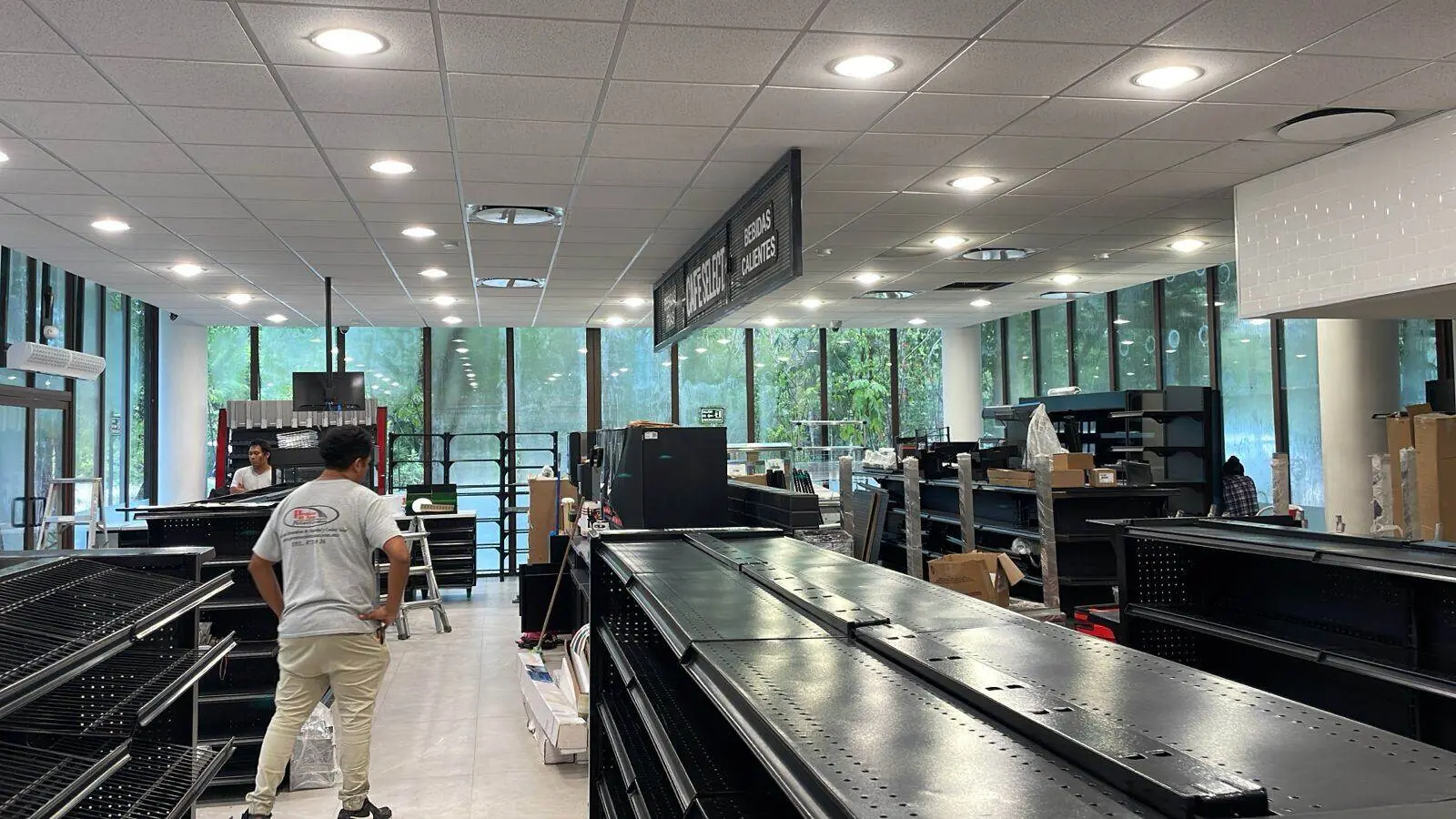
A gym is a deceptively technical building. It puts dynamic impact loads on a slab, needs a cooling and dehumidification load closer to a commercial kitchen than an office, has to move large volumes of air quietly, and carries a sanitary fit-out — showers, lockers, changing rooms — that has to survive constant wet use in a humid climate. Get any of those wrong and members notice within a week.
This covers the specification that matters for gyms in the Riviera Maya: what to do about the floor, how to size the air systems for a climate where sweat does not evaporate, wet-area detailing that lasts, and what different gym formats cost per square metre.
Floors and Slab Loading
The slab first. A dropped loaded barbell delivers a large, brief, concentrated impact, and an Olympic or CrossFit area needs a slab designed for it — not an ordinary commercial floor with rubber on top. On a ground-bearing slab this means specifying the loading, the thickness and the reinforcement for the platform zones. On a suspended slab — a gym on an upper floor, which is common in mixed-use buildings here — it requires structural assessment, and the answer is frequently to restrict free-weight dropping to a designed zone with dedicated support, or to use dead-blow platforms.
Then the floor build-up, by zone:
| Zone | Build-up | MXN/m² |
|---|---|---|
| Free weights / lifting platforms | 20–50 mm rubber tile over designed slab, or timber platform inserts | $1,200–$3,200 |
| Machines and general floor | 8–12 mm rubber roll or tile | $600–$1,400 |
| Functional / turf area | Sled-rated artificial turf on shock pad | $900–$2,200 |
| Studio (yoga, pilates, dance) | Sprung timber or vinyl sports floor | $1,400–$3,500 |
| Cardio | Rubber with vibration isolation under treadmills | $700–$1,600 |
Two local notes. Rubber flooring and humidity: seal the substrate and allow the slab to dry properly before laying, or moisture rises and lifts the adhesive. And vibration transmission — in a mixed-use building, a treadmill or a dropped weight travels through the structure into the apartment or office next door, and isolation details at the floor and at the wall junction are much cheaper than the dispute afterwards.
The Air System Is the Whole Job
This is where gyms in tropical climates are made or ruined. Bodies at exercise produce heat and a great deal of moisture; at 80% ambient humidity, sweat does not evaporate efficiently, so the room feels far worse than the thermometer says and members leave.
- Size the cooling load from occupancy, not area. A gym's sensible and latent loads at peak occupancy are far above an office of the same size. Treat peak class attendance as the design case.
- Dehumidification as a distinct requirement. Air conditioning sized purely for temperature will hold 24°C at 70% humidity, which is unpleasant for exercise. Either oversize for latent capacity with correct part-load behaviour, or add dedicated dehumidification.
- Fresh air and extraction. Mechanical ventilation with a real outdoor-air rate, extraction from changing rooms and showers, and no recirculation of changing-room air into the gym floor.
- Air movement where people are. Large-diameter low-speed fans plus directed supply. Perceived comfort in a gym is mostly air movement.
- Noise. Diffusers and fans selected for low noise — a studio with a roaring supply grille cannot run a yoga class.
- Redundancy. Two or more units per zone rather than one large one, so a failure degrades the space instead of closing it. In this climate a gym with no cooling is a closed gym.
Budget for it honestly: on a gym, the mechanical package is typically the largest single trade after the floor and the equipment, and it is the one that determines whether members renew.
Get a Free Quote in 2 Minutes
Tell us about your project — we respond via WhatsApp faster than any builder in the Riviera Maya
Wet Areas, Compliance and Cost by Format
Showers and changing rooms are the second most common complaint and the most common maintenance problem. What works: full waterproofing membrane under tile with proper falls to linear drains, large-format porcelain rather than small mosaic (fewer joints), 316 stainless fixings and fittings throughout, mechanical extraction running on a timer past closing, ventilated lockers, sealed benches on legs, and hot water sized for the peak — a class finishing at the same moment is the design case, and an undersized water heater turns into a review problem immediately. Given local water hardness, a softener upstream protects every shower fitting and heater in the building.
Compliance. Civil Protection with egress sized for real occupancy, emergency lighting, extinguishers and a defined assembly point; accessibility including an accessible WC and, where possible, accessible changing provision; NOM-compliant electrical with the load schedule built around equipment and air systems; and a music licensing arrangement, which is an operating rather than construction item but a real one.
| Format | Fit-out MXN/m² | Notes |
|---|---|---|
| Boutique studio (yoga, pilates, spin), 100–200 m² | $9,000–$18,000 | Floor and air systems dominate |
| Functional / CrossFit box | $8,000–$16,000 | Slab design and rig anchorage are the technical items |
| Full commercial gym with changing rooms | $14,000–$28,000 | Wet areas and mechanical drive the cost |
| Hotel or condo fitness room | $12,000–$22,000 | Vibration isolation is critical — guests sleep next door |
| Equipment package (separate) | $1,200,000–$6,000,000 total | Long lead times into Quintana Roo |
One strategic note for this market: gyms serving a resident population behave differently from those serving hotels and short-stay visitors. A resident gym needs changing rooms, lockers and a class programme; a hotel fitness room needs excellent air conditioning, quiet equipment, vibration isolation and a view, and almost no wet area. Decide which you are building before the plan is drawn — the two briefs produce different buildings at similar cost.
Frequently Asked Questions
We Build Across the Riviera Maya
Playa del Carmen
Our home base since 2008. Playacar, Centro, Ejidal, Colosio, Coralina — we know every colonia and every permit office.
Tulum & Aldea Zamá
Eco-builds, boutique hotels, jungle villas. Full SEMA/SEMARNAT permit handling. Eco-regulation experts.
Puerto Aventuras
Marina-front villas, canal homes, gated community construction & renovation since 2010.
Cancún & Hotel Zone
Commercial builds, restaurant fit-outs, condo renovations in Zona Hotelera and residential zones.
Akumal & Puerto Morelos
Beachfront construction, eco-resorts, residential builds in protected coastal zones.
Bacalar & Felipe Carrillo Puerto
Emerging market — boutique hotels, eco-lodges on the Lagoon of Seven Colors.
Ready to Start Your Project?
196+ projects completed. Fixed-price contracts. Free detailed estimate within 48 hours.
Get Free QuoteWhy Build with Recrea
- 196+ projects completed across the Riviera Maya — Playa del Carmen, Tulum, Puerto Aventuras, Cancún, Akumal, Bacalar since 2008
- Fixed-price contracts — itemized budget, no surprises, penalty clauses for delays
- All services in-house — architecture, permits, construction, electrical, plumbing, carpentry, metalwork, pool
- Bilingual team — English/Spanish/German communication with weekly photo and video reports
- 100% permit approval rate — land use, SEMA, construction license, civil protection, all inspections
- 14 rescued projects — we've taken over and completed projects abandoned by other builders
- 1-year structural warranty — we stand behind our work with written guarantees