Gas station construction and refurbishment in Puerto Morelos
Double-wall tanks, forecourt, canopy and the CRE-ASEA file with a single contractor.
Highway 307 at Puerto Morelos carries tourism, freight and local traffic all day. It is a good place for a fuel station and, at the same time, one of the most demanding in the country on containment: below is karst and the aquifer is a few metres down.
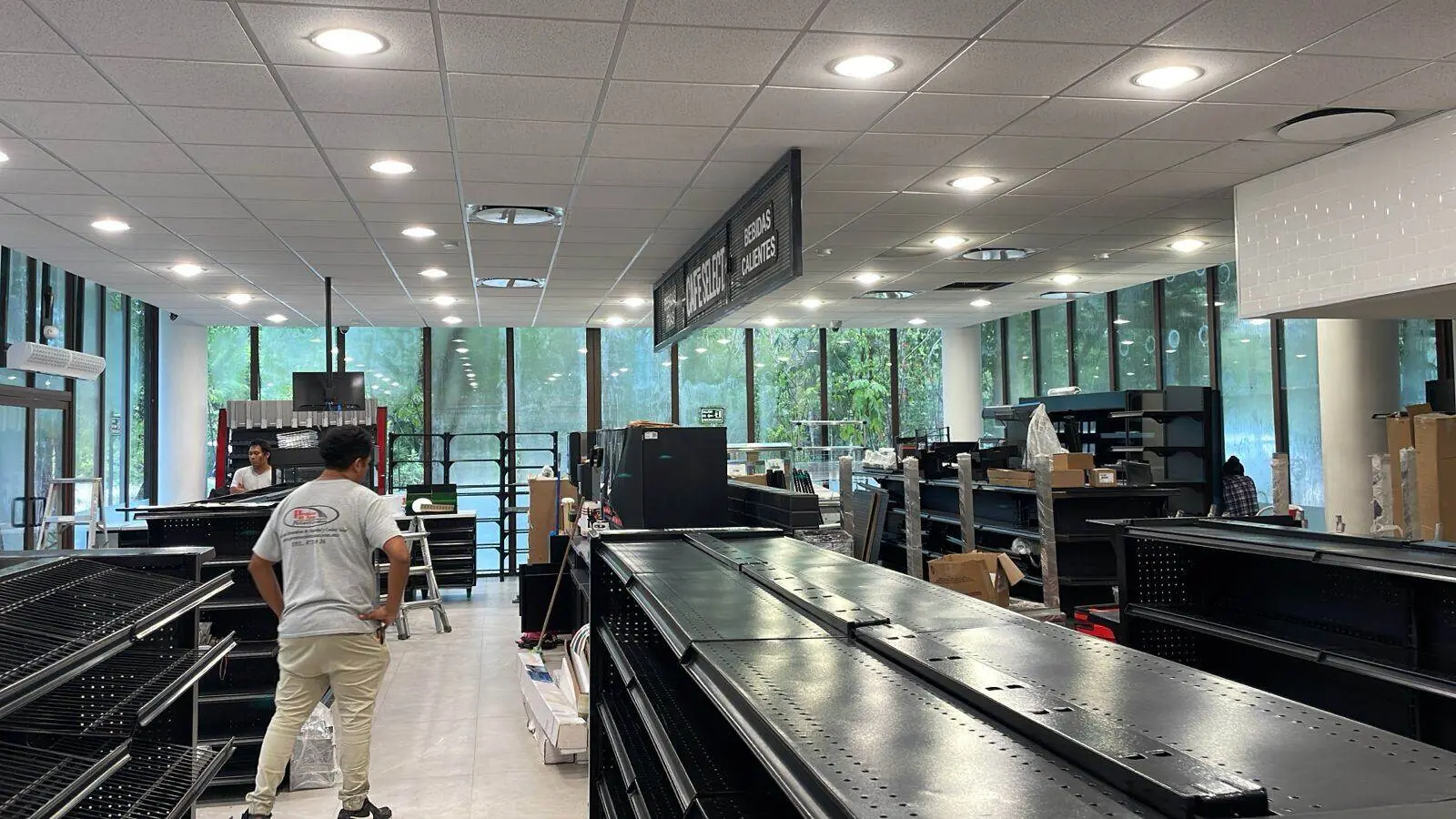
Karst and aquifer: why containment governs here
The ground does not filter: it conducts. A leak in fractured limestone reaches the aquifer in hours, not years, and the whole area drinks from that aquifer. So the design starts from double-wall tanks with interstitial monitoring, double-contained piping, a bund and impermeable paving at the delivery area, and a separator trap on the forecourt drainage. It is not an optional upgrade: it is the basis of the file.
CRE, ASEA and NOM-005: the file that sets the calendar
A fuel station needs a retail permit from the Energy Regulatory Commission, an industrial safety and environmental protection authorisation from ASEA, and compliance with NOM-005-ASEA for design, construction and operation. Added to that are municipal land use, the licence, Protección Civil and the federal highway junction. That set, not the construction, is what marks the opening date.
Access and flow: what makes highway frontage profitable
The value is in getting in and out without friction. Acceleration and deceleration lanes, radii for a tourist coach and a tractor-trailer, islands oriented to the dominant direction and a convenience store that does not obstruct circulation. All of that depends on the junction authorised by the federal roads authority, which is pursued before the design is committed.
Budget and programme for a station in Puerto Morelos
As a 2026 reference, a new three-island station with double-wall tanks, double-contained lines, dispensers, canopy, convenience store and forecourt works sits between MXN 12 and 24 million in construction and installation, excluding land, brand rights and working capital. A full refurbishment with tank replacement runs MXN 3 to 8 million.
A realistic total programme is eight to fourteen months: the CRE permit and the ASEA authorisation dominate the calendar, the federal junction runs in parallel, and civil works and installation take four to seven months. So the schedule is built backwards from the filings, not forwards from the construction.
Scope: from the permit to a station dispensing fuel
We cover concept and executive design with services engineering, calculation records and specifications for the ASEA file, integration of the CRE retail permit, land use and the municipal licence, Protección Civil sign-off, management of the highway junction, civil works, tanks and lines, dispensers, canopy, convenience store, forecourt works and commissioning tests.
The budget comes out as line items with quantities and unit rates; every change is priced and signed before execution and payments go against verified progress. We hand over as-built drawings, calculation records, tightness certificates and equipment manuals.
Why the calendar is built from the filings
The civil works of a station are predictable: four to eight months depending on size. What is not predictable are the CRE permit, the ASEA authorisation and the highway junction, which run in months and do not depend on the contractor. So we start the file before the final executive design and run the three fronts in parallel rather than chaining them.
Weekly reports with dated photographs and a fortnightly video call from site, in Spanish, English, German, French, Russian or Chinese. We work with investors and operators who do not live in the area and need to follow both works and filings remotely.
The ground in Puerto Morelos: what it imposes on the project
- Municipality: Puerto Morelos
- Environmental regime: SEMARNAT (reef national park) + ZOFEMAT
- Ground: limestone, mangrove to the west
- Water table: high near the coast
- Salt exposure: severe on the front row
Independent municipality since 2016 — different authority, rulebook and timelines from Benito Juárez and Solidaridad.
- Federal SEMARNAT filing: the environmental resolution is the project’s critical path. Budget 4–8 months before the first excavation.
- ZOFEMAT frontage: the federal strip is not yours even if you buy the lot — it is concessioned separately and paid for annually.
- High water table: the foundation sits higher and the pool needs anchoring against uplift.
- Severe salt exposure: 316 stainless throughout the hardware, concrete cover above the code minimum and six-monthly maintenance. 304 pits within two years at this distance from the sea.
- Mangrove on the parcel: protected under federal law. The real buildable footprint can be a fraction of the lot.
Compare with the other 40 zones in the zone checker.
Frequently asked questions
Can I use single-wall tanks if the ground looks solid?
No. In fractured limestone, a double wall with interstitial monitoring is what separates a leak detected in time from aquifer contamination. Beyond the regulatory requirement, it is the difference between a contained incident and an environmental liability that outlives the business.
Which filing takes longest?
Usually the ASEA authorisation and the CRE permit, which run in months, not weeks. The federal junction also has its own timeline. Civil works are the predictable part; the filings are what move the date, which is why they are started first and run in parallel.
Do you only do the works, or the permit file too?
Both, and in practice they are inseparable: the drawings, calculation records and specifications the ASEA file requires are the same ones that govern the works. We assemble the file, respond to observations and coordinate the CRE retail permit with its holder.
What tests are handed over at the end?
Tightness certificates for tanks and lines, verification of the interstitial monitoring system, dispenser tests, as-built drawings, calculation records and manuals. Without that package the station cannot demonstrate compliance, and it is the first thing asked for in any later review.
Fuel stations on the Riviera Maya · Commercial construction · Zone checker · Cost calculator · House construction in Puerto Morelos · Villas and hotels in Puerto Morelos · Luxury villas in Puerto Morelos · Clinics in Puerto Morelos · Warehouses in Puerto Morelos