Gas Station Construction in the Riviera Maya
Where to build and what changes between municipalities
A service station is a federally regulated installation wherever it stands: the permit to operate comes from the CRE and industrial safety from ASEA. What the location changes is the construction file on top of that — and the cost of the hole in the ground.
The federal track is identical; the construction file is not
CRE and ASEA apply everywhere in Mexico. On top of them, inland Solidaridad and Benito Juárez add a purely municipal construction file — the shortest route on the corridor. Tulum adds the state SEMA to every project, so three authorities instead of two. Puerto Morelos has run its own file since 2016. On a coastal or marina frontage, ZOFEMAT joins.
The tank pit is where the budget differs
Inland the limestone is compact and the water sits well below: the tanks need no anchoring against flotation and containment is designed for containment. That is the least expensive pit on the corridor, and the pit is where much of a station budget lives.
Towards the coast the water rises and the tanks have to be anchored. In the Tulum municipality the ground is cenote country: void verification before the excavation is priced, and containment designed on the assumption that anything leaving the pit reaches groundwater fast. Ground and water by zone are in the zone checker.
Remodelling without closing
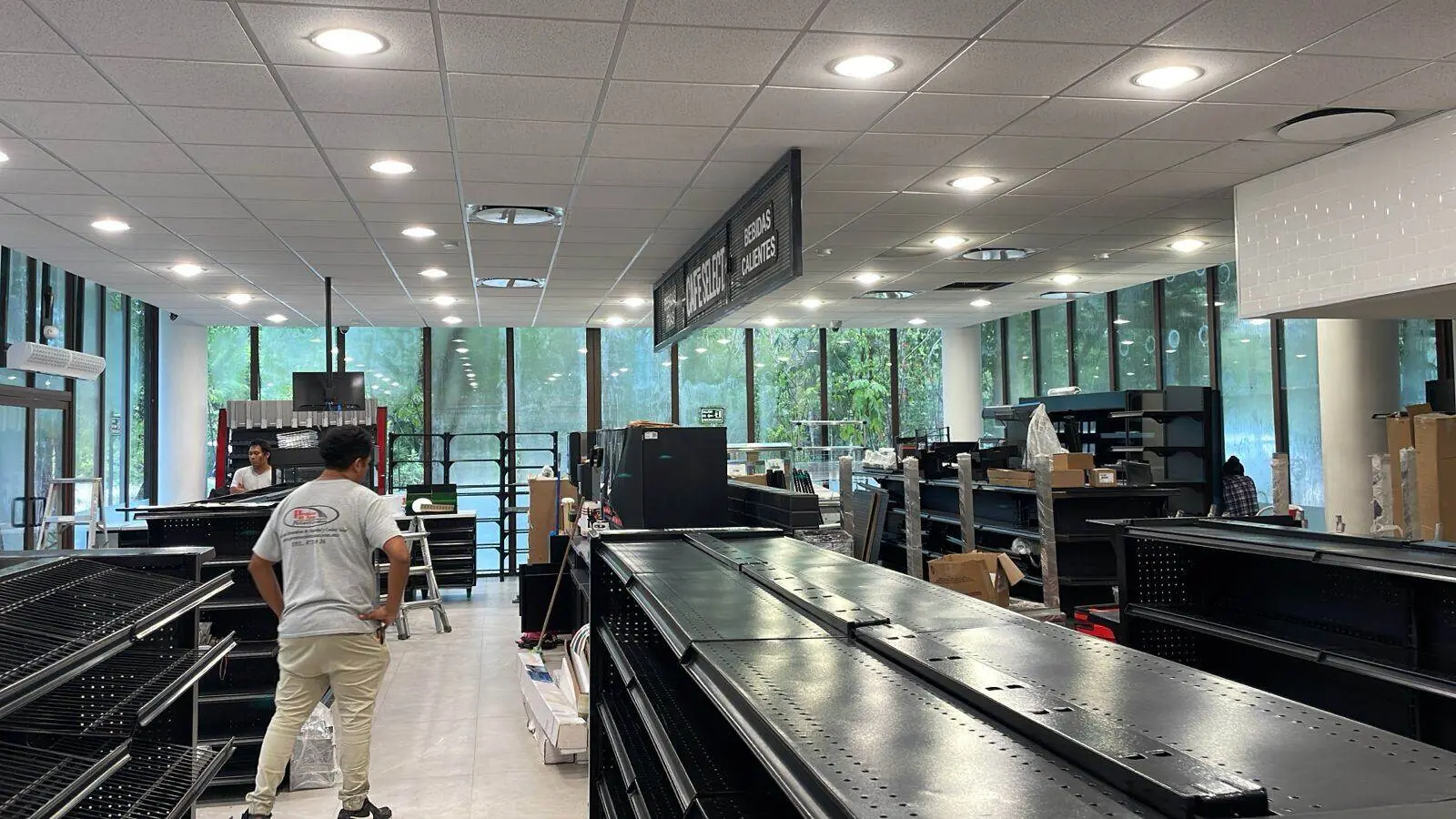
Most station work is a remodel, and on a high-throughput urban site closing costs more than the work. We phase island by island, with fuel delivery windows and customer circulation agreed in writing before the first barrier goes up, and hot works scheduled away from the tank farm.
Canopy steel, fixings and island trim are specified for the real distance to the coast, with the maintenance interval handed over in writing. Forecourt falls drain to the interceptor from every point — set wrong on paper, they become standing contaminated water on site.
Cost and how we contract
On a service station a large share of the cost sits below the surface. The tank pit, the containment, the piping and the interceptor drive the budget harder than the shop and the canopy do, and that part depends entirely on ground and water. On this building type, a price without a soil study is not a price.
We contract in two stages: site investigation, alignment with the CRE and ASEA sequence, and a concept with a cost range; then a fixed price for construction. On a remodel the phasing plan joins the contract, because it is the line item that decides how much trade is lost while the works run.
Frequently asked questions
Do you handle the CRE and ASEA filings?
We run the construction file and coordinate with whoever runs the federal track — usually the brand or the owner’s specialist. We guarantee the works programme matches the regulatory sequence.
Where is a station fastest to build?
Inland Solidaridad or Benito Juárez: a purely municipal construction file. Tulum adds the state SEMA. The federal track is the same everywhere and usually sets the real date.
Do the tanks need anchoring?
Inland, generally not. Towards the coast, yes, and the containment design changes with it. Soil and water data decides it, before pricing.
Can the station keep trading?
Usually yes, phased island by island, with delivery windows and customer routes agreed in writing.
Do you work to a brand image manual?
Yes. We have built retail to franchise specification, including 7-Eleven and GoMart.
Service stations in Cancún · In Playa del Carmen · In Tulum · Commercial construction · Zone checker